QSTS: a day on sp_case14 in two modes
Level: Advanced, builds on the OLTC chapter of the basic tour.
Note: This workshop was created with AI assistance and is reviewed and curated by the maintainer; it is not a fully machine-generated text.
A quasi-static time series (QSTS) solves one power flow per step of a series of operating states. Sparlectra has two modes. Mode A (snapshots) solves every step on its own. Mode B (sequential) solves the steps in order and carries the tap and bank positions from one step to the next, so the controllers act as they would over a day. This workshop runs the shipped example day on sp_case14 in both modes and shows where the results differ.
Warm-up and the example series
Julia compiles each function on first use. This cell loads the package and reads the series, so any chapter can run on its own after it; a code cell that uses a name from another cell says so in a comment. Its last line, warmup(), runs every path the chapters use once on the first two steps of the day; its code is in docs/lit/warmup/workshop_qsts.jl of the package. How long the warm-up takes depends on the machine.
The series is data/qsts/sp_case14_day.qsts.zip: the case file sp_case14.scf.json as base and 96 steps of 15 minutes. Each step is a list of patch operations against the base case: the eight loads follow a daily shape, the two machines other than the reference follow the load. From 14:00 to 15:45 the line Ostheim_Neuwiese_1 (component id 26) is out, one more operation in those eight steps. The taps and the shunt are not in the series.
using Sparlectra
using Printf

# the shipped series and the controller file next to it
data = joinpath(dirname(dirname(pathof(Sparlectra))), "data", "qsts")
series = read_scf_series(joinpath(data, "sp_case14_day.qsts.zip"))
control_file = joinpath(data, "sp_case14_day.control.yaml")
println("series ", series.name, ": ", length(series.steps), " steps of ", Int(series.step_minutes), " min (", series.steps[1].label, " to ", series.steps[end].label, "), ", sum(length, series.ops), " patch operations")
outage = only(filter(op -> op.op === :status, series.ops[57]))
println("step 57 (", series.steps[57].label, "), status operation: ", outage.target, " ", outage.id, " status set to ", outage.value, " (0 = out of service)")

# compile every path the chapters use once; the warm-up code is in
# docs/lit/warmup/workshop_qsts.jl of the installed package
include(pkgdir(Sparlectra, "docs", "lit", "warmup", "workshop_qsts.jl"))
warmup()
series sp_case14_day: 96 steps of 15 min (00:00 to 23:45), 968 patch operations
step 57 (14:00), status operation: branch 26 status set to 0.0 (0 = out of service)
warm-up: compiles the paths of this workshop once; how long it takes depends on the machine
warm-up: 26.17 s (series, mode A, mode B, accessors, chart, files); everything warm1. The switch qsts.mode
runQsts takes the run mode from the configuration key qsts.mode. The default is off, and with it runQsts refuses to run. The two other values are snapshots (mode A) and sequential (mode B).
# uses: series (warm-up cell)
println("default qsts.mode: ", SparlectraConfig().qsts.mode)
refusal = try
    runQsts(series; config = SparlectraConfig())
    "ran"
catch err
    err isa ArgumentError || rethrow()
    sprint(showerror, err)
end
println(refusal)
default qsts.mode: off
ArgumentError: runQsts: qsts.mode is off; set qsts.mode = snapshots or sequential2. Mode A: every step on its own
Mode A solves the base case, then every step on a fresh copy of the base network with the delta of the step applied, started from the base solution. Nothing is carried from one step to the next, so the steps can run in parallel. Without qsts.snapshot_controls = true no controller runs: the taps stay where the case file puts them.
qstsValues(result, element_id, quantity) returns one quantity of one element over all steps, NaN where a step has no value. On an SCF series the element id is the component id of the case file: bus 8 is Moorau_20, bus 14 Wehrden_20, branch 26 the line that goes out at 14:00. An empty id selects a step quantity.
# uses: series (warm-up cell)
config_a = SparlectraConfig(Dict{String,Any}("qsts" => Dict{String,Any}("mode" => "snapshots")))
plain = redirect_stdout(() -> runQsts(series; config = config_a), devnull)
labels = [s.label for s in plain.steps]
vm_moorau = qstsValues(plain, "8", "vm_pu")
vm_wehrden = qstsValues(plain, "14", "vm_pu")
line_out = findall(isnan, qstsValues(plain, "26", "p_from_mw"))
println("mode A: ", count(s -> s.status === :solved, plain.steps), " of ", length(plain.steps), " steps solved, controller status ", join(unique(s.control_status for s in plain.steps), ", "))
println("branch 26 Ostheim_Neuwiese_1, P at the from side: no value from ", labels[first(line_out)], " to ", labels[last(line_out)], " (out of service)")
println("bus voltage Vm [pu] over the day, mode A without controllers (power flow result):")
println("  bus                 lowest   highest   steps below 0.99 pu")
for (name, vm) in (("Moorau_20 (bus 8)", vm_moorau), ("Wehrden_20 (bus 14)", vm_wehrden))
    @printf("  %-19s %6.4f   %6.4f    %2d\n", name, minimum(vm), maximum(vm), count(<(0.99), vm))
end
println("  Moorau_20 below 0.99 pu from ", labels[findfirst(<(0.99), vm_moorau)], " to ", labels[findlast(<(0.99), vm_moorau)])
mode A: 96 of 96 steps solved, controller status none
branch 26 Ostheim_Neuwiese_1, P at the from side: no value from 14:00 to 15:45 (out of service)
bus voltage Vm [pu] over the day, mode A without controllers (power flow result):
bus lowest highest steps below 0.99 pu
Moorau_20 (bus 8) 0.9850 1.0129 11
Wehrden_20 (bus 14) 0.9760 0.9954 67
Moorau_20 below 0.99 pu from 18:00 to 20:30Without control the evening peak (18:00 to 20:30) pulls Moorau_20 below 0.99 pu, and Wehrden_20 stays below 1.0 pu all day.
3. Mode B: the day in order with controllers
The file sp_case14_day.control.yaml holds the controllers for this day. The case file already has a tap controller on Moorau_110_20 (target 1.0 pu at Moorau_20, deadband 0.01 pu); the file gives it the range tap_min: 1.0, adds a tap controller on Wehrden_110_20 (1.0 pu at Wehrden_20) and turns the shunt at Moorau_20 into a switched bank of 2.5 MVAr blocks behind the Moorau tap (priority: 1, target 1.01 pu, deadband 0.02 pu). load_sparlectra_config reads it, the override sets the mode.
Each step starts from the solution of the step before and from the taps and bank of its end. A controller has the address <actuator>#<kind>: 30#OLTC is the Moorau transformer, 31#OLTC the Wehrden transformer, 8#MSC the bank at bus 8. Its position is the tap step (0 at ratio 1.0) or, for the bank, the number of blocks.
# uses: control_file, series (warm-up cell)
config_b = load_sparlectra_config(control_file; reload = true, overrides = Dict("qsts" => Dict("mode" => "sequential")))
day = redirect_stdout(() -> runQsts(series; config = config_b), devnull)
println("mode B: ", count(s -> s.status === :solved, day.steps), " of ", length(day.steps), " steps solved")
println("controller position, mode B (OLTC: tap step, 0 at ratio 1.0; MSC: blocks in service):")
println("  controller  name               at 00:00   changed to")
for (id, name) in zip(day.elements.controller_ids, day.elements.controller_names)
    position = qstsValues(day, id, "position")
    changes = [k for k in 2:length(position) if position[k] != position[k - 1]]
    println("  ", rpad(id, 12), rpad(name, 19), lpad(Int(position[1]), 8), "   ", join([string(Int(position[k]), " at ", day.steps[k].label) for k in changes], ", "))
end
mode B: 96 of 96 steps solved
controller position, mode B (OLTC: tap step, 0 at ratio 1.0; MSC: blocks in service):
controller name at 00:00 changed to
30#OLTC 16 OLTC 0 1 at 00:45, 0 at 06:30, 1 at 22:00
31#OLTC 17 OLTC 0 -1 at 06:15, -2 at 08:00
8#MSC msc_Moorau_20 MSC 0 1 at 18:00The Moorau tap goes one step up at 00:45, back to its limit 1.0 at 06:30 and up again at 22:00. The Wehrden tap goes two steps down in the morning and stays there. At 18:00 the Moorau tap is at its limit and the voltage falls below 0.99 pu, so the bank switches in one block. It stays in for the rest of the day: with the block in, the voltage stays inside the band of the bank.
qstsSwitching lists every step in which a position changed against the end of the step before, with old and new position and the trigger. qstsMetrics counts the moves, finds hunting (up, down, up within qsts.hunting_window steps) and sums the loss energy.
# uses: day (3. Mode B: the day in order with controllers)
@isdefined(day) || error("Run the section \"3. Mode B: the day in order with controllers\" first: it sets up day.")
sw = qstsSwitching(day)
println("switching list, mode B:")
println("  time   controller  position old -> new   trigger")
for i in eachindex(sw.step)
    println("  ", rpad(day.steps[sw.step[i]].label, 7), rpad(sw.element_id[i], 12), lpad(sw.old[i], 12), " -> ", rpad(sw.new[i], 6), sw.trigger[i])
end
metrics = qstsMetrics(day)
metric(id, name) = metrics.value[only(i for i in eachindex(metrics.metric) if metrics.element_id[i] == id && metrics.metric[i] == name)]
println("metrics, mode B:")
println("  switching operations, all controllers:     ", Int(metric("", "switch_count_total")))
println("  hunting patterns, all controllers:         ", Int(metric("", "n_hunting_total")))
@printf("  loss energy of the day [MWh]:              %.2f\n", metric("", "loss_energy_mwh"))
println("  30#OLTC Moorau, steps at the tap limit:    ", Int(metric("30#OLTC", "steps_at_limit")), " of ", length(day.steps))
switching list, mode B:
time controller position old -> new trigger
00:45 30#OLTC 0 -> 1 control
06:15 31#OLTC 0 -> -1 control
06:30 30#OLTC 1 -> 0 control
08:00 31#OLTC -1 -> -2 control
18:00 8#MSC 0 -> 1 control
22:00 30#OLTC 0 -> 1 control
metrics, mode B:
switching operations, all controllers: 6
hunting patterns, all controllers: 0
loss energy of the day [MWh]: 21.91
30#OLTC Moorau, steps at the tap limit: 65 of 96Six moves in 96 steps and no hunting. The loss energy is the sum of the step losses times 15 minutes.
4. One chart
qstsChart draws one quantity of one element over the steps as SVG, one point per step with a tooltip, the band dashed. Here Wehrden_20 in mode B with the deadband of its tap controller, 0.99 to 1.01 pu. A notebook and the documentation show the returned chart directly; its field svg holds the text for a file.
# uses: day (3. Mode B: the day in order with controllers)
@isdefined(day) || error("Run the section \"3. Mode B: the day in order with controllers\" first: it sets up day.")
chart = qstsChart(day, "14", "vm_pu"; band = (0.99, 1.01))
println("Wehrden_20 (bus 14), Vm [pu], mode B (power flow result):")
@printf("  lowest of the day:                 %.4f\n", minimum(chart.values))
@printf("  highest of the day:                %.4f\n", maximum(chart.values))
@printf("  band of 31#OLTC (dashed):          %.2f to %.2f\n", chart.band...)
chart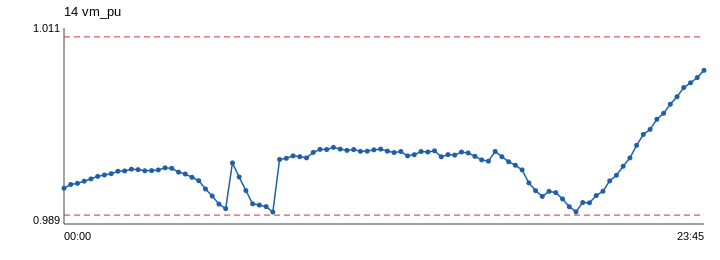
In mode A without control the same bus stays below 0.99 pu in 67 steps (section 2). In mode B it stays inside the band all day.
5. What differs between the modes
Mode A can run the controllers too: qsts.snapshot_controls = true runs the controllers of the configuration in every step, but every step starts again from the taps and the bank of the case file. We run it with the same controller file and compare with mode B.
# uses: control_file, series (warm-up cell); day (3. Mode B: the day in order with controllers)
@isdefined(day) || error("Run the section \"3. Mode B: the day in order with controllers\" first: it sets up day.")
config_ac = load_sparlectra_config(control_file; reload = true, overrides = Dict("qsts" => Dict("mode" => "snapshots", "snapshot_controls" => true)))
each = redirect_stdout(() -> runQsts(series; config = config_ac), devnull)
step_changes(v) = count(k -> v[k] != v[k - 1], 2:length(v))
println("step 1 (", day.steps[1].label, "), all bus values equal in mode A and mode B: ", isequal(each.bus_values[:, :, 1], day.bus_values[:, :, 1]))
println("                                                 mode A    mode B")
println("tap ratio changes between consecutive steps:")
for (id, name) in (("30", "Moorau_110_20 (30)"), ("31", "Wehrden_110_20 (31)"))
    @printf("  %-45s %6d    %6d\n", name, step_changes(qstsValues(each, id, "tap_ratio")), step_changes(qstsValues(day, id, "tap_ratio")))
end
k = 22
println(day.steps[k].label, ", power flow result:")
@printf("  %-45s %6.4f    %6.4f\n", "tap ratio Moorau_110_20 (30) [pu]", qstsValues(each, "30", "tap_ratio")[k], qstsValues(day, "30", "tap_ratio")[k])
@printf("  %-45s %6.4f    %6.4f\n", "Vm Moorau_20 (bus 8) [pu]", qstsValues(each, "8", "vm_pu")[k], qstsValues(day, "8", "vm_pu")[k])
k = 84
println(day.steps[k].label, ", power flow result:")
@printf("  %-45s %6.4f    %6.4f\n", "Vm Moorau_20 (bus 8) [pu]", qstsValues(each, "8", "vm_pu")[k], qstsValues(day, "8", "vm_pu")[k])
@printf("  %-45s %6s    %6.1f\n", "bank 8#MSC in service [MVAr]", "n/a", qstsValues(day, "8#MSC", "bs_mvar")[k])
println("whole day:")
@printf("  %-45s %6d    %6d\n", "Newton iterations, sum over 96 steps", sum(s.iterations for s in each.steps), sum(s.iterations for s in day.steps))
@printf("  %-45s %6d    %6d\n", "switching rows", length(each.switching), length(day.switching))
@printf("  %-45s %6d    %6d\n", "metric rows", length(each.metrics), length(day.metrics))
step 1 (00:00), all bus values equal in mode A and mode B: true
mode A mode B
tap ratio changes between consecutive steps:
Moorau_110_20 (30) 2 3
Wehrden_110_20 (31) 10 2
05:15, power flow result:
tap ratio Moorau_110_20 (30) [pu] 1.0000 1.0125
Vm Moorau_20 (bus 8) [pu] 1.0094 0.9965
20:45, power flow result:
Vm Moorau_20 (bus 8) [pu] 0.9908 1.0021
bank 8#MSC in service [MVAr] n/a 2.5
whole day:
Newton iterations, sum over 96 steps 642 219
switching rows 0 6
metric rows 0 24Step 1 is the same in both modes: mode B starts the day from the base solution, as mode A starts every step. After that the history decides.
- A deadband allows more than one position. At 05:15 both Moorau positions hold
Moorau_20inside 0.99 to 1.01 pu. Mode A starts from the case tap 1.0 and finds no reason to move; mode B still stands at 1.0125 from 00:45 and finds no reason either. - In mode A the position follows the load. The Wehrden tap changes between consecutive steps ten times in mode A and twice in mode B. A change in mode A is no switching operation: each step searches its position from the tap of the case file.
- Mode B keeps the bank in. At 20:45 mode A starts with the bank off;
Moorau_20at 0.991 pu lies inside the band of the bank, so it stays off. Mode A reports no controller values, so its bank column reads n/a. Mode B carries the block from 18:00 into the night, and the voltage is above 1.0 pu. - Mode B is cheaper per step. It starts each step from the step before; mode A needs more than twice the Newton iterations.
- Only mode B counts. Switching list and metrics exist in mode B only;
writeQstsResultswritesqsts_switching.csvandqsts_metrics.csvfor it.
Mode A, snapshots | Mode B, sequential | |
|---|---|---|
| steps | independent, parallel | in order; several series in parallel |
| controllers | off, or each step from the base case (qsts.snapshot_controls) | the control section, taps and banks carried |
| start of a step | base solution | the step before |
| results | values per step | values, switching list, metrics |
| use | the set points of the source system per step | controller behaviour over a day |
6. The result files
writeQstsResults writes the long table, the steps, the elements and a manifest. Mode B adds the switching list and the metrics.
# uses: day (3. Mode B: the day in order with controllers); plain (2. Mode A: every step on its own)
@isdefined(day) || error("Run the section \"3. Mode B: the day in order with controllers\" first: it sets up day.")
@isdefined(plain) || error("Run the section \"2. Mode A: every step on its own\" first: it sets up plain.")
# format="technical" fixes comma and decimal point; the default follows the regional settings
files_a = writeQstsResults(mktempdir(), plain; format = "technical")
files_b = writeQstsResults(mktempdir(), day; format = "technical")
println("mode A: ", join(basename.(files_a), ", "))
println("mode B: ", join(basename.(files_b), ", "))
mode A: qsts_values.csv, qsts_steps.csv, qsts_elements.csv, qsts_manifest.json
mode B: qsts_values.csv, qsts_steps.csv, qsts_elements.csv, qsts_switching.csv, qsts_metrics.csv, qsts_manifest.jsonWhere to go from here
- QSTS: Snapshot Series: the modes, the series format, the result quantities and the configuration keys.
- The example
examples/others/exp_scf_series.jlruns the same day as a script and solves one step by hand withapply!andrunpf!. - In the Web UI the button QSTS runs a series file and shows the chart of any bus or branch.